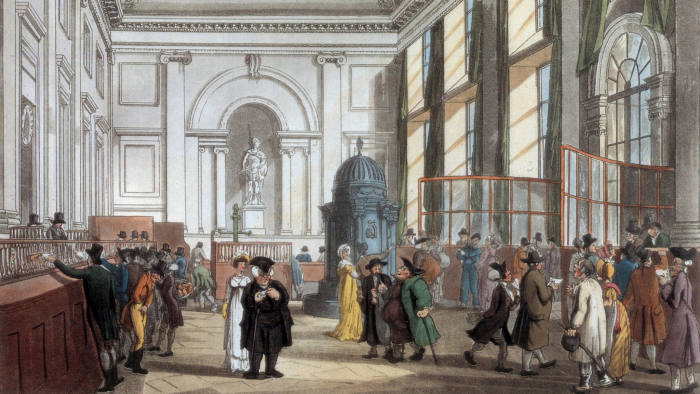
Where does the wealth of a nation lie? It’s a tricky question to answer as it’s one of those annoying scenarios in which just about everyone will have a different answer for you. A Tory might tell you that the wealth is drawn from that nation’s physical resources; what is being produced and what could potentially be produced. A Whig might stress the importance of commerce and international trade, and that simply looking at a nation as a closed system of finite resources was both reductive and lacking in ambition. In this period of history, new ideas and theories about wealth were being catapulted into the mainstream with rapid economic growth and a vast, ever growing hunger to accumulate more. With the establishment of the Dutch East India Trading Company in 1602, it could be argued that the foundations for modern Western capitalism were being laid for centuries to come. Adam Smith wouldn’t come to publish his seminal work “An Inquiry into the Nature and Causes of the Wealth of Nations” until 1776, and while there were plenty of professionals working in the finance sector at this time there was certainly a lack of general understanding as to how finance could truly work. At this point in time, mercantilism (a belief in which the world’s wealth was a static figure, and that therefore it was in the best interest of a nation to accumulate as much wealth as possible by exporting as much as possible while enforcing tariffs on imports) was the prevailing economic theory which, while it had its merits, placed severe restrictions on the understanding of how global economics could properly function. All this is to say, that while expectations for finances were high, general knowledge and understanding of how it actually worked was severely limited in the early 1700s when the South Sea trading Company was founded.
Britain in the 1600s was enjoying rapid growth in its production despite the numerous troubles domestically and abroad. Increasing production and international trade led to the rise of more modern financial enterprises. This left many people with excess capital with which to invest, and without the proper laws and safeguards in place those with the knowledge and resources were able to effectively play the market like a musical instrument. Between the period of Charles II’s restoration in 1660 and 1700, over 100 Royal Charters were issued by the crown. These charters allowed the registered company to issue limited joint stock, a practice that originated in the Netherlands that was becoming increasingly popular in Britain. While all of this sounds like fantastic news for the finances of the realm, it was little consolation to Robert Harley, the new Chancellor of the Exchequer, in 1711 when he first walked into his office and noticed the alarming note left behind by his predecessor;
“…how you will restore credit, and find the money for the demands that will be upon you exceeds my capacity” – Wrote Lord Halifax.
At this time, each government department kept its own budget, with funds being raised on credit independently from each other. After carefully reading the stark warning, and performing an in depth review of the Government’s finances, Harley’s heart must have sunk as he tallied up debts that amounted to around £9million. But even after this review, Harley couldn’t be 100% sure that this figure was the true final sum of the debts. To give you some idea of how ruinous this debt was at the time, in 2015 British Chancellor George Osborne announced that the government was going to be refinancing and make new payments on this debt, 300 years later!
Where these debts had come from was no great mystery; Britain simply couldn’t get enough of going to war at this time. The days of feudal lords calling up their vassals to perform military service as part of their obligation to their liege were long gone in Britain. A continental army and a supporting navy were ruinously expensive to maintain, and Harley believed he would need to find £300,000 in cash just to keep the government going for the next year of warfare. The Bank of England had been established as a means to find this credit (in fact the original charter specifically mentions the war as a main objective for establishing the bank in the first place), but that was a staunchly Whig institution, and the Whigs were in no way inclined to help out their Tory rivals in power. Not only was the board of directors exclusively staffed by Whigs who opposed his politics on a professional level, but the Tory tolerance of Catholic freedoms enforced an ideological barrier that simply couldn’t be breached. After all, the continental wars that were draining the treasury were initially about the conflict between the established Catholic Church and the rise in Protestantism sweeping the Christian world. Faced with no obvious means of generating funds, and a timeline that would mean the collapse of the entire British economy if he failed to meet it, Harley was forced to get creative.
Ask any economist about the history of banking and credit in general and invariably they will bring up the goldsmiths. The general story is that as the primary holders of capital, it made sense for citizens to deposit their gold with the artisans (who frequently employed their own security) and this excess capital could then be loaned out to others seeking credit. In theory this worked just fine for the purposes of private credit creation, but these goldsmiths were entirely decentralised and lacked any regulation; it was not unheard of for a smith to loan out money at 33% or higher interest. The lack of regulation led to a highly volatile market, and all it took was one Smith to go bankrupt and an entire chain reaction of enterprises and families being ruined. Asking the goldsmiths for credit was, therefore, entirely out of the question for Harley when he was seeking money for the government coffers.
Another method for raising cash quickly that Harley considered had been to run a state lottery. These had been running for a while now, specifically to generate capital for the 9 year’s war, and could be effective at finding liquid funds for rapid use in government. The way it worked was that each ticket would cost £10, and could pay out up to £1,000 each. Each ticket was guaranteed a pay-out, but it would be over the course of multiple years, so the tickets were effectively a loan where the pay-out was a complete gamble. It had been useful to previous chancellors, and (due to it being state backed, and specifically for the purpose of raising war funds) for many of the middle classes who didn’t have the money to spend on joint stock, the lottery offered a way for citizens to express a sense of patriotism. The problem with this had become clear during the war: if the government was completely out of cash they would be unable to pay the winners, leaving many to believe that government lotteries were too risky to invest in. Thus, this avenue was closed to him, at least for now.
In the past there had been attempts to set up a Land Bank in Britain. The idea was similar to the Bank of England in terms of its purpose being to support the Government treasury, but these had generally been unsuccessful. Harley tried to revitalise the idea and proposed a new Land Bank that would take loans from landowners all across the kingdom and then be able to loan that capital out with interest to generate profit. Harley was, however, completely unable to break this cycle of inept land banks as when it came time to register interested donors, no one turned up. As it happens, all of the interest he had managed to generate in the time leading up to its formation had been purely from those wishing to borrow money, as they had nothing to lend. This was a deeply humiliating blow, not just as a professional blunder but it severely undercut Tory ideology in that the wealth of the nation lay in its land and resources.
What Harley needed was money, and fast, and he was in no position to opine as to where it came from. The solution was to find a dastardly scheme and the right man lacking in all scruples to run it. Enter stage right: John Blunt, director of the Hollowsword Blade Company. Had the company still actually been in the business of making swords the irony of his name would have been the main reason he was remembered to history, but as it happened, it was his total moral bankruptcy in pursuit of maximum financial gain that brought him into this particular story. Stick around to find out how Blunt managed to pay for vast amounts of government land using essentially nothing but the government’s own money, and then landing the most lucrative job in Britain as a reward from those very ministers he had just ripped off.
 The Money Trail